
Getting traffic to your website feels great. But here's the truth — traffic alone means nothing if visitors leave without doing anything. You might have thousands of people visiting your pages every month. Yet, if none of them fill out a form, buy something, or reach out, your SEO efforts are not really working for you. This is where marketing funnels come in.
A marketing funnel is simply the journey a person takes from first hearing about your brand to finally becoming a loyal customer. It gives your marketing a clear direction. Instead of treating all visitors the same, you guide each one step by step with the right message at the right time. In this guide, you will learn exactly what a marketing funnel is, how it works with SEO, and how to build one that consistently turns visitors into leads, sales, and long-term growth.
What Is a Marketing Funnel?
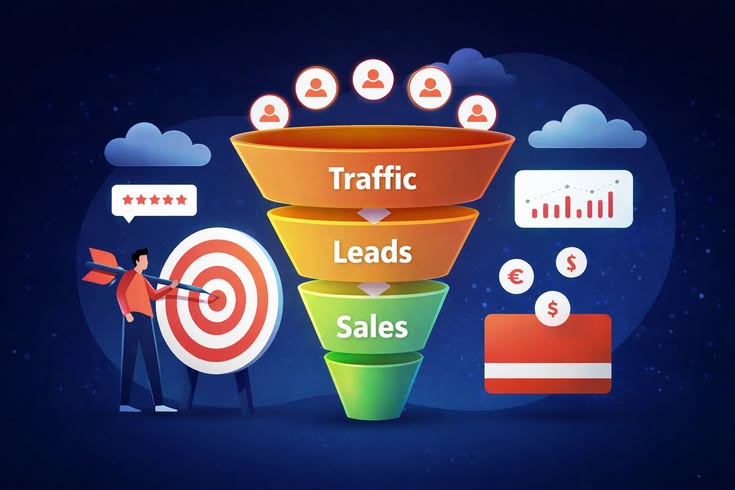
A marketing funnel is a structured path that shows how people move from first discovering your brand to eventually buying from you — and even recommending you to others. Think of it as a real funnel shape. At the very top, a large number of people discover your website or content. As they move down, some leave, while others stay and show interest. By the time they reach the bottom, the people left are the most interested ones — the ones ready to take action.
Most marketers divide the funnel into three main zones:
- Top of Funnel (TOFU) – Awareness stage. People discover your brand or seek general information.
- Middle of Funnel (MOFU) – Consideration stage. People know their problem and compare solutions.
- Bottom of Funnel (BOFU) – Decision stage. People are ready to buy or take action and need a final push.
Each zone needs a different type of content and a different strategy. A blog post that works great at the top of the funnel may not help at all at the bottom.
Why Traffic and Leads Are Not the Same Thing
One of the biggest mistakes businesses make is thinking that more traffic automatically meansmore leads or sales That is simply not true. A visitor becomes a lead only when they show real interest and share their information with you — like signing up for an email list, downloading a guide, or requesting a consultation. Just browsing your website does not make someone a lead.
Four things decide whether your traffic turns into leads:
- Relevance – Are the right people landing on your pages?
- Intent match – Does your page answer exactly what the visitor came looking for?
- Value – Is there a good enough reason for them to take the next step?
- Low friction – Is the process easy, fast, and clear?
When all four of these work together, your funnel starts producing results.
How SEO Feeds the Funnel at Every Stage
SEO is not just about ranking high on Google. When done right, it feeds every stage of your marketing funnel — from awareness all the way down to decisions. Here is how SEO connects to each stage:
Awareness stage: SEO-optimized blog articles, how-to guides, educational videos, and infographics help people discover your brand when they search for general information. These pieces do not try to sell anything. They simply answer questions and build awareness.
Consideration stage: SEO helps your comparison pages, case studies, product deep-dives, and FAQ pages appear when people search for specific solutions. These visitors already know their problem — they are now trying to find the best answer.
Decision stage: Your service pages, pricing pages, testimonial sections, and demo request pages need SEO too. When someone searches for your brand name or a very specific solution, you want to show up and give them one final, compelling reason to choose you.
Smart SEO strategy maps keyword research to funnel stages. Broad, informational keywords go at the top. Comparison and solution keywords go in the middle. And action-intent keywords, like "hire," "buy," or "get a quote," go at the bottom.
How to Build a Marketing Funnel That Converts SEO Traffic
Step 1: Know Your Audience First
Before you write a single word of content or build a single page, you need to understand who you are trying to reach. What are their biggest problems? What do they search for online? What do they compare before making a decision? Use tools like Google Analytics, Google Search Console, and even simple customer surveys to find out what your audience cares about most. The better you understand them, the easier it becomes to create content that speaks directly to their needs at each stage.
Step 2: Map the Customer Journey
Once you know your audience, map out how they typically find and interact with your brand. Think about every place they might encounter you — from social media posts and blog articles to email campaigns and product pages. Identifying these touchpoints helps you spot gaps in your funnel. Maybe you have great top-of-funnel content but nothing to guide visitors from awareness to consideration. Or maybe your content is strong but your landing pages are confusing. Mapping the journey shows you exactly where to focus.
Step 3: Create the Right Content for Each Stage
Content is the engine that powers every stage of your funnel. But not all content works the same way at every stage.
Top of funnel: Blog articles, short videos, beginner guides, social media posts – educate and attract.
Middle of funnel: Case studies, product comparisons, webinars, tutorials, detailed FAQs – build trust.
Bottom of funnel: Customer testimonials, clear pricing pages, demo requests, limited-time offers – drive action.
Step 4: Use Lead Magnets to Capture Information
A lead magnet is a free, valuable resource you offer in exchange for someone's contact information. Think downloadable templates, checklists, free guides, mini-courses, or access to a webinar. Lead magnets work because they give visitors a clear reason to take the next step. Instead of asking someone to "buy now" from a cold first visit, you offer them something useful. Once they share their email, you have permission to keep the conversation going through follow-up emails and nurture sequences.
Step 5: Optimize Your Landing Pages
A landing page has one job: to get the visitor to take the next action.Good landing pages have a clear headline that matches what the visitor expected, a simple and focused design, a strong call to action, and as little distraction as possible. Mobile optimization also matters enormously. More than half of all web traffic today comes from phones. If your landing page loads slowly or looks broken on a small screen, you lose leads before they even read your offer.
Step 6: Nurture Leads with Follow-Up Sequences
Most people do not buy the first time they visit your site. In fact, it often takes several touchpoints before someone feels ready to make a decision. This is why lead nurturing is so important. Once someone enters your funnel by downloading a resource or signing up for your list, you continue to reach them through a series of helpful emails. These emails do not push hard sales right away. Instead, they build trust over time by sharing useful information, addressing common concerns, and guiding the person toward the next step at their own pace.
Step 7: Convert at the Bottom with Strong Calls to Action
At the decision stage, your visitor has done their research. They know their problem. They have compared options. Now they just need a clear, confident reason to choose you. Your bottom-of-funnel content and pages should include honest testimonials from real customers, clear descriptions of what you offer and how it works, transparent pricing or a way to request a custom quote, and a simple, direct call to action like "Book a Free Call" or "Get Started Today."
The Benefits of a Well-Built Marketing Funnel
- ✔ It brings the right people in. By aligning your SEO strategy with funnel stages, you attract visitors who are already interested in what you offer — not random people who will never convert.
- ✔ It turns more visitors into leads. With good lead magnets, optimized landing pages, and clear calls to action, more of your existing traffic takes meaningful steps forward.
- ✔ It builds long-term trust. A nurture sequence keeps your brand present in a helpful, non-annoying way, so people feel comfortable buying from you when they're ready.
- ✔ It reduces wasted effort. When every piece of content and every page has a clear funnel role, you stop creating content that gets traffic but produces no results.
- ✔ It improves customer retention. A good funnel does not end at the sale. Smart post-purchase communication turns one-time buyers into loyal customers who come back and refer others.
Advanced Tips to Improve Funnel Performance
- • Track where people leave. Use Google Analytics to see which pages have high exit rates. These are your funnel's weak spots — fix them first.
- • Qualify your leads. Not every lead deserves the same follow-up. Use signals like which offer they downloaded and which pages they visited to focus on the most promising leads.
- • Align content with search intent. A blog post that pushes too hard for a sale will turn people off. A bottom-funnel page that covers only basic education won't convert. Match the goal to the stage.
- • Test and improve over time. Your first funnel won't be perfect. Keep measuring, testing small changes, and improving. Even a slight conversion lift at each stage compounds into significant growth.
Conclusion
SEO brings people to your door. A marketing funnel takes them from that door all the way to becoming loyal customers. Without a funnel, most of your SEO traffic leaves without ever giving you a chance. With a funnel, every visitor enters a structured experience that guides them naturally toward a decision — at their own pace, without pressure.
The key is to start simple: understand your audience, create the right content for each stage, offer something valuable in exchange for contact information, and follow up in a way that builds genuine trust. Then keep testing and improving. Marketing funnels are not a one-time project. They are a living system that grows more effective over time as you learn what your audience truly needs. Start building yours today — and watch your SEO traffic finally start working the way it should.
Frequently Asked Questions
Q1: What is the difference between a marketing funnel and a sales funnel?
A marketing funnel covers the entire journey from awareness to loyalty, including brand discovery and content engagement. A sales funnel typically refers to the narrower path from lead qualification to closing a deal. In most businesses, the two work together.
Q2: How long does it take to see results from a marketing funnel?
Most businesses begin to see improvement in lead quality within 2 to 3 months of implementing a structured funnel. Long-term growth compounds over time as content ranks and nurture sequences mature.
Q3: Do I need paid ads to make a marketing funnel work?
No. Organic SEO can effectively feed the top of your funnel without paid advertising. However, combining SEO with targeted paid ads can speed up results, especially at the bottom of the funnel.
Q4: What is the most important stage of the funnel?
Every stage matters, but the middle of the funnel (consideration) is often the most neglected. Many businesses have strong awareness content and a clear sales process, but they fail to nurture leads through the research and comparison phase — and that's where most people drop off.
Q5: How do I know if my funnel is working?
Track key metrics at each stage: organic traffic volume, lead capture rate, email open and click rates, and conversion rate on landing pages. If traffic is high but leads are low, fix your lead capture. If leads are high but conversions are low, focus on your bottom-funnel content and follow-up process.
Q6: Can YS Digital Services help me build a marketing funnel?
Yes. YS Digital Services specializes in helping businesses create SEO-aligned marketing funnels that attract the right traffic, capture more leads, and convert them into sustainable growth. Reach out to explore how a custom funnel strategy can work for your business.